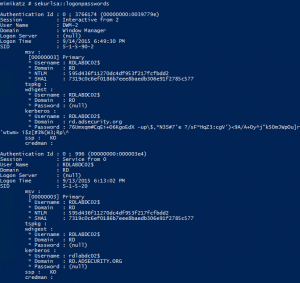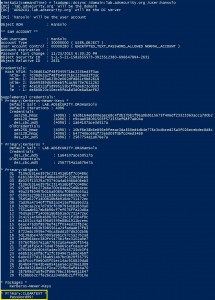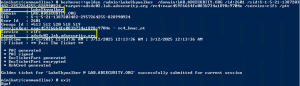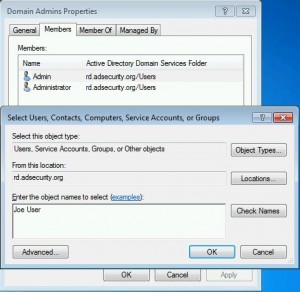

Microsoft’s Kerberos implementation in Active Directory has been targeted over the past couple of years by security researchers and attackers alike. The issues are primarily related to the legacy support in Kerberos when Active Directory was released in the year 2000 with Windows Server 2000. This legacy support is enabled when using Kerberos RC4 encryption …

Category: Technical Reference
Dec 28 2015
Finding Passwords in SYSVOL & Exploiting Group Policy Preferences
At Black Hat and DEF CON this year, I spoke about ways attackers go from Domain User to Domain Admin in modern enterprises. Every Windows computer has a built-in Administrator account with an associated password. Changing this password is a security requirement in most organizations, though the method for doing so is not straight-forward. A …
Dec 14 2015
Unofficial Guide to Mimikatz & Command Reference
A new page on ADSecurity.org just went live which is an “unofficial” guide to Mimikatz which also contains an expansive command reference of all available Mimikatz commands. Screenshots, descriptions, and parameters are included where available and appropriate. This page includes the following topics: Mimikatz Overview Mimikatz & Credentials Available Credentials by OS PowerShell & Mimikatz …
Nov 22 2015
Dump Clear-Text Passwords for All Admins in the Domain Using Mimikatz DCSync
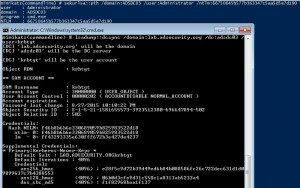
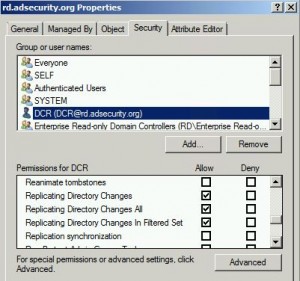
The two key goals of any attack is access and persistence. This post covers elements of each. In a post-exploitation scenario where the attacker has compromised the domain or an account with delegated rights, it’s possible to dump the clear-text passwords of admins without being a Domain Admin*. This method requires the Active Directory Domain …
Nov 17 2015
How Attackers Use Kerberos Silver Tickets to Exploit Systems
Usually Golden Tickets (forged Kerberos TGTs) get all the press, but this post is about Silver Tickets and how attackers use them to exploit systems. I have talked about how Silver Tickets can be used to persist and even re-exploit an Active Directory enterprise in presentations at security conferences this year. This post continues this …
Oct 14 2015
The Most Common Active Directory Security Issues and What You Can Do to Fix Them
The past couple of years of meeting with customers is enlightening since every environment, though unique, often has the same issues. These issues often boil down to legacy management of the enterprise Microsoft platform going back a decade or more. I spoke about Active Directory attack and defense at several security conferences this year including …
Sep 26 2015
Sneaky Active Directory Persistence Tricks
The content in this post links to several methods through which an attacker could persist administrative access to Active Directory after having Domain Admin level rights for 5 minutes. While there are an infinite number of actions an attacker can perform after compromising an enterprise, there are a finite number of pathways. In this series, …
Sep 25 2015
Sneaky Active Directory Persistence #15: Leverage AdminSDHolder & SDProp to (Re)Gain Domain Admin Rights
The content in this post describes a method by which an attacker could persist administrative access to Active Directory after having Domain Admin level rights for 5 minutes. I presented on this AD persistence method at DerbyCon (2015). Complete list of Sneaky Active Directory Persistence Tricks posts AdminSDHolder Overview AdminSDHolder is an object located in …
Sep 25 2015
Sneaky Active Directory Persistence #13: DSRM Persistence v2
The content in this post describes a method by which an attacker could persist administrative access to Active Directory after having Domain Admin level rights for 5 minutes. I presented on this AD persistence method at DerbyCon (2015). I also presented and posted on DSRM as a persistence method previously. Complete list of Sneaky Active …
Sep 25 2015
Mimikatz DCSync Usage, Exploitation, and Detection
Note: I presented on this AD persistence method at DerbyCon (2015). A major feature added to Mimkatz in August 2015 is “DCSync” which effectively “impersonates” a Domain Controller and requests account password data from the targeted Domain Controller. DCSync was written by Benjamin Delpy and Vincent Le Toux. The exploit method prior to DCSync was …


Recent Comments