The content in this post describes a method by which an attacker could persist administrative access to Active Directory after having Domain Admin level rights for about 5 minutes. All posts in my Sneaky Active Directory Persistence Tricks series This post explores how an attacker could leverage computer account credentials to persist in an enterprise …
Category: Microsoft Security
Mar 02 2016
ADSecurity.org’s Unofficial Guide to Mimikatz & Command Reference Updated for Mimikatz v2.1 alpha 20160229
ADSecurity.org’s Unofficial Guide to Mimikatz & Command Reference page is updated for the new modules/features in Mimikatz v2.1 alpha 20160229. According to Mimikatz author, Benjamin Delpy, the following updates are included in the most recent Mimikatz version(s): Mimikatz Release Date: 2/29/2016 2.1 alpha 20160229 (oe.eo) edition System Environment Variables & other stuff [new] System Environment …
Feb 11 2016
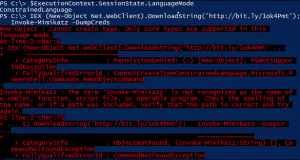
Detecting Offensive PowerShell Attack Tools
At DerbyCon V (2015), I presented on Active Directory Attack & Defense and part of this included how to detect & defend against PowerShell attacks. Update: I presented at BSides Charm (Baltimore) on PowerShell attack & defense in April 2016. More information on PowerShell Security: PowerShell Security: PowerShell Attack Tools, Mitigation, & Detection The most …
Feb 11 2016
PowerShell Version 5 Security Enhancements
PowerShell version 5 is RTM (As of 12/18/2015). Prior to this there was a “production preview” available since August which means it was supported, but not final. With the final release of PowerShell v5 now available, I highly recommend you download PowerShell v5 and start testing to prepare for production deployment. While the PowerShell v5 …
Jan 31 2016
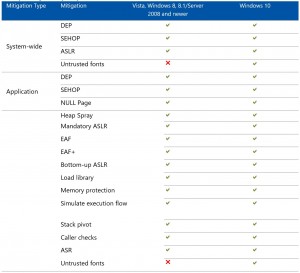
Microsoft EMET 5.5 Released – Benefits, New Features, Protection, Logging, & GPO Config
Microsoft recently released Enhanced Mitigation Experience Toolkit (EMET) version 5.5 (it jumped from 5.2 to 5.5) which includes Windows 10 compatibility and better GPO support (among others). I’ve included information from a variety of Microsoft sources in this post so that others don’t have to search for the data separately. The resources/references are listed at …
Jan 27 2016
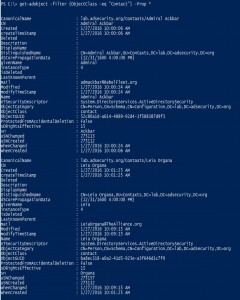
Active Directory Recon Without Admin Rights
A fact that is often forgotten (or misunderstood), is that most objects and their attributes can be viewed (read) by authenticated users (most often, domain users). The challenge is that admins may think that since this data is most easily accessible via admin tools such as “Active Directory User and Computers” (dsa.msc) or “Active Directory …
Jan 05 2016
Mimikatz Update Fixes Forged Kerberos Ticket Domain Field Anomaly – Golden Ticket Invalid Domain Field Event Detection No Longer Works
In late 2014, I discovered that the domain field in many events in the Windows security event log are not properly populated when forged Kerberos tickets are used. The key indicator is that the domain field is blank or contains the FQDN instead of the short (netbios) name and depending on the tool used to …
Jan 03 2016
How Attackers Dump Active Directory Database Credentials
I previously posted some information on dumping AD database credentials before in a couple of posts: “How Attackers Pull the Active Directory Database (NTDS.dit) from a Domain Controller” and “Attack Methods for Gaining Domain Admin Rights in Active Directory“. This post covers many different ways that an attacker can dump credentials from Active Directory, both …
Jan 01 2016
Attack Methods for Gaining Domain Admin Rights in Active Directory
There are many ways an attacker can gain Domain Admin rights in Active Directory. This post is meant to describe some of the more popular ones in current use. The techniques described here “assume breach” where an attacker already has a foothold on an internal system and has gained domain user credentials (aka post-exploitation). The …
Dec 31 2015
Cracking Kerberos TGS Tickets Using Kerberoast – Exploiting Kerberos to Compromise the Active Directory Domain
Microsoft’s Kerberos implementation in Active Directory has been targeted over the past couple of years by security researchers and attackers alike. The issues are primarily related to the legacy support in Kerberos when Active Directory was released in the year 2000 with Windows Server 2000. This legacy support is enabled when using Kerberos RC4 encryption …


Recent Comments